France is in the semifinals
And Their Children After Them“France is in the semifinals” is the recurring phrase through which the 1998 FIFA World Cup enters everyday life in Heillange. Heard over radios and loudspeakers, repeated at work and in bars, it first announces an approaching match and then gathers people into a shared celebration. Its force lies in that movement from routine news to collective feeling: for a time, even old antagonisms seem to yield to the excitement of the game.
A phrase across everyday life
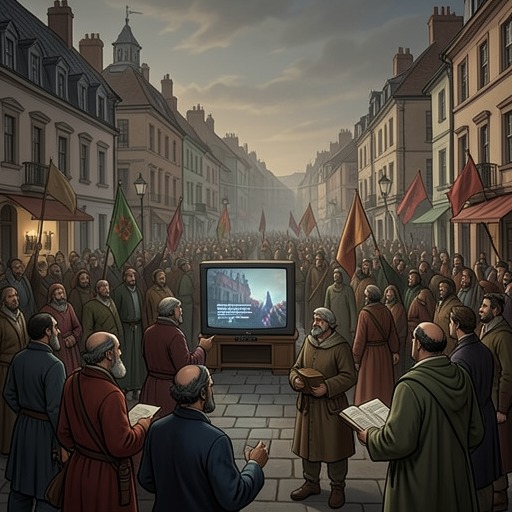
The refrain reaches Anthony Casati during an ordinary shopping trip. At E.Leclerc, announcements about the team’s progress accompany exceptional television discounts, and shoppers crowd the electronics department. Anthony buys a large television, while highlights from the previous match play across a wall of screens. The phrase makes a sporting result part of the store’s sales pitch, but the scene also shows how thoroughly the event has entered public conversation: Anthony expects to discuss the news with acquaintances he meets around town.
The same words circulate at Hacine Bouali’s workplace. Customers, salesmen, warehouse workers, and drivers talk about football; even the mood among the staff resembles the excitement before a holiday. The expression thus travels across settings and kinds of work, turning a shared broadcast into a common point of reference. Its repetition is not confined to committed supporters: it is the atmosphere in which ordinary errands and working hours unfold.
Private strain beside the public excitement
For Hacine, the country’s excitement contrasts with a troubled home life. Rather than go straight home, he joins workmates at a bistro to watch France play Denmark. He wants to see the match but is also avoiding the apartment, his in-laws, and the crying baby. Preoccupied with the scene he expects at home, he misses the opening goal and leaves at halftime, frustrated and uneasy.
When he returns, Coralie and the baby are gone, and Hacine reads Coralie’s note saying she has taken the baby to her parents’ home. He feels relief, eats alone, and watches the rest of the match. The refrain continues to structure the day around him, but it does not resolve his private conflict: in the shower, he still wonders what is happening in his life and feels trapped. The contrast makes the phrase a measure of the distance between collective exhilaration and individual distress, not a promise that one will repair the other.
From announcement to shared event
The refrain gains a different force when Anthony and Hacine separately make their way into L’Usine during the France-Croatia semifinal. They recognize one another, but initially attend to the match rather than their history. When Lilian Thuram scores in the forty-seventh minute, the bar erupts. Anthony and Hacine are caught up in the same celebration; Anthony shakes Hacine in his excitement, and Hacine raises both fists. The phrase that has accompanied the buildup now belongs to a room reacting together in real time.
Thuram’s second goal, at the seventieth minute, intensifies that temporary unity. The narration presents the crowd as swept into a single shared experience, with old debts and divisions momentarily seeming to disappear. Anthony drinks and celebrates alongside his cousin and other spectators; Hacine also drinks heavily. The event does not erase their past antagonism, but it creates a pause in which neither is simply an outsider to the celebration.
The refrain fulfilled
When the match ends, Heillange spills into the streets. Cars jam the roads, flags appear at windows, young people set off firecrackers, and strangers toast and embrace. The celebration is expressed in collective language: people say that they have won and that they are going to the final. Even Algerian flags appear among the French colors, while the local National Front office has temporarily closed its shutter. The scene makes the apparent breadth—and the limits—of the moment’s togetherness visible.
Around midnight or one in the morning, Anthony and Hacine find themselves outside L’Usine. They have spent the evening avoiding one another, but victory, drink, and the atmosphere of amnesty finally make an approach possible. The repeated phrase has passed from commercial announcement to shared anticipation and then to fulfillment. Its unity remains temporary, yet the encounter shows that the match’s collective mood can briefly alter how people meet one another.